How to Avoid Beachfront Construction Noise: The 2026 Audit
The selection of a coastal retreat is often driven by the pursuit of “Acoustic Purity”—the rhythmic, low-frequency white noise of breaking waves that serves as a biological reset for the modern nervous system. However, the high-value nature of littoral real estate creates a paradox: the more desirable a stretch of coastline becomes, the more likely it is to be a site of constant structural transformation. Beachfront construction is not merely a localized nuisance; it is an industrial-scale operation involving heavy machinery, hydraulic pile driving, and logistics that can permeate the “Soundscape” of a resort for miles.
Navigating this risk requires a transition from the “Vacationer” mindset to that of a “Spatial Auditor.” Most travelers rely on the good faith of hospitality marketing or outdated review aggregates, both of which are systemically inclined to minimize the presence of nearby development. Because construction cycles in tropical or coastal environments are often delayed by weather or seasonal permits, a “quiet” resort in February can become an active industrial zone by March. To achieve a truly restorative stay, one must learn to identify the early markers of development and understand the physics of how sound travels over water and sand.
This editorial audit deconstructs the systemic drivers of coastal development and provides a definitive framework for achieving acoustic sovereignty. By understanding the “Lifecycle of a Construction Permit” and applying “Topographical Sound Mapping,” the traveler can move from a state of hopeful guessing to calculated avoidance. The goal is to ensure that the primary auditory input of your stay remains the ocean, rather than the staccato rhythm of a jackhammer or the high-frequency beeping of a reverse-gear alarm.
Understanding “how to avoid beachfront construction noise”
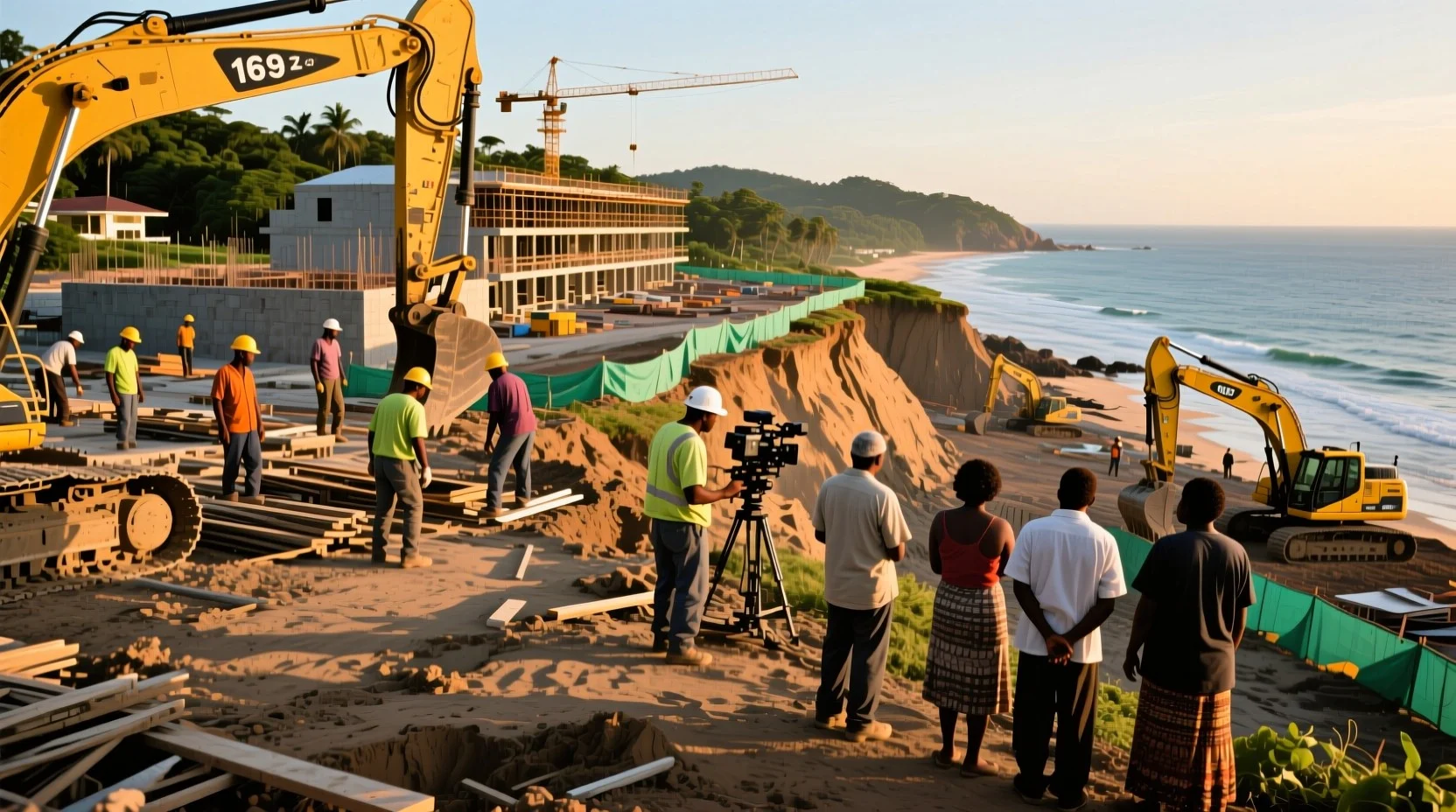
To effectively master how to avoid beachfront construction noise, one must first understand that “Proximity” is not the only variable. In coastal environments, sound behaves according to the principles of “Atmospheric Refraction.” Because water is a dense, flat surface, it acts as an acoustic mirror, reflecting sound waves over long distances with minimal attenuation. A construction project three properties down the beach can often sound as if it is happening on your own balcony. Managing this risk requires a multi-perspective audit that accounts for wind direction, building orientation, and the “Acoustic Shadow” of the resort itself.
A common misunderstanding is the belief that “Interior Rooms” or “Garden View” options are a safe fallback. While these rooms may be shielded from the visual sightline of the construction, they often face internal resort corridors or service roads where the secondary noise of construction—delivery trucks, worker staging areas, and waste management—is concentrated. The oversimplification risk here is assuming that if you can’t see the crane, you can’t hear the work. In reality, low-frequency vibrations from heavy machinery can travel through a building’s foundation, creating a “Sub-Bass” hum that is impossible to mask with white noise machines.
Furthermore, we must address the “Permit Lag.” Many travelers assume that if a hotel website doesn’t mention construction, then no construction is occurring. However, hotels are often the last to disclose nearby third-party projects over which they have no control. Learning how to avoid beachfront construction noise involves looking past the hotel’s self-reporting and investigating the “Development Pipeline” of the surrounding municipality. It is an exercise in identifying “In-Fill” potential—the empty lot, the aging 1970s motel next door, or the “Soft” green space that is zoned for high-density residential use.
Historical and Systemic Evolution of Coastal In-Fill
The history of beachfront tourism is a narrative of “Successive Replacement.” Initially, coastal destinations were characterized by small-scale, low-impact structures. As global wealth and travel accessibility increased, these “Legacy Properties” became the targets of “In-Fill Development.” This is the systemic process where every available square meter of oceanfront land is maximized for yield. This evolution has led to a state of “Permanent Renovation,” where resorts must constantly upgrade their amenities to remain competitive, creating a cycle of construction that never truly ends.
In the late 20th century, construction was largely seasonal, halted during “Peak Dates” to protect the guest experience. However, the modern financialization of the hotel industry—where properties are owned by private equity firms rather than families—has prioritized “Development Velocity” over guest comfort. Modern construction techniques, such as pre-fabricated modular units, allow projects to move faster, but they require massive staging areas and heavy-lift helicopters, which have significantly expanded the “Acoustic Footprint” of a typical project.
By 2026, we are seeing the rise of “Extreme Coastal Engineering.” As sea levels rise, many resorts are engaged in “Beach Nourishment” (pumping sand from offshore) or “Sea Wall Hardening.” These are not traditional building projects, but they involve massive industrial dredgers and 24-hour pumping operations. The systemic reality is that the “Pristine Beach” is now a managed industrial asset, and the traveler must account for the maintenance of that asset in their planning.
Conceptual Frameworks and Mental Models
To achieve acoustic seclusion, one must apply specific mental models that deconstruct the resort environment.
1. The “Acoustic Shadow” Model
This model suggests that you should position yourself behind a “Mass Barrier.” Just as light creates a shadow, building mass creates an acoustic shadow. A room that is situated in a wing perpendicular to the construction site, with a large concrete structure between the balcony and the noise source, will experience significantly lower decibel levels.
2. The “Wind-Vector” Analysis
Sound is a physical wave carried by air. If the prevailing winds are blowing from the construction site toward your resort, the noise will be “Carried” and amplified. Conversely, if the wind is blowing out to sea or away from your room, the “Perceived Noise” can drop by as much as 10–15 decibels. This model requires checking local “Wind Roses” for your travel dates.
3. The “Zoning Maturity” Framework
This framework assesses the “Stability” of the surrounding land. A “Mature” zone is one where all lots are occupied by modern, high-value structures that are unlikely to be demolished soon. A “Vulnerable” zone is one with empty lots, “Teardown” properties, or ongoing public works (like new sewage lines).
Key Categories of Development and Trade-offs
Identifying the source of the noise allows for a more targeted avoidance strategy.
| Category | Primary Noise Type | Duration | Strategy |
| New High-Rise | Pile driving; Cranes | 18–36 Months | Avoid the entire “Neighborhood.” |
| Resort Renovation | Jackhammering; Grinding | 3–6 Months | Check “Active Wing” maps. |
| Beach Nourishment | Low-frequency hum | 2–4 Weeks | Monitor “Dredge Schedules.” |
| Infrastructure/Road | Heavy trucks; Beeping | 6–12 Months | Request rooms far from “Street-Side.” |
| Private Villa Build | Power tools; Radio noise | 12 Months | Verify “Lateral Neighbors.” |
Decision Logic: If the noise is “Structural” (pile driving), no amount of earplugs or white noise will suffice due to the vibration. If the noise is “Curb-Side” (deliveries), a high-floor, ocean-facing room will typically provide an adequate acoustic buffer.
Detailed Real-World Scenarios
The “Empty Lot” Oversight
A traveler books a luxury villa based on photos showing a pristine palm grove next door.
-
The Flaw: The palm grove was a “Land Bank” lot. Construction on a new 10-unit complex began two weeks before arrival.
-
The Outcome: The “Infinity Pool” experience is dominated by the sound of a cement mixer 20 feet away.
-
The Resolution: Using “Satellite History” tools to see if a lot has been recently cleared or if “Rebar” is visible in current imagery.
The “Internal Refurbishment” Trap
A guest chooses a resort that claims “No nearby construction.”
-
The Flaw: The hotel is renovating its own “Grand Ballroom” or “Kitchen Exhaust” system.
-
The Outcome: The noise is “Structure-Borne,” vibrating through the vents into the room.
-
The Resolution: Specifically asking the concierge: “Are there any internal maintenance or capital improvement projects occurring inside the building during my stay?”
The “Dredging” Surprise
A traveler goes to a Caribbean island for “Peace.”
-
The Flaw: They arrive during the annual “Sand Pumping” window to restore the beach after hurricane season.
-
The Outcome: 24/7 industrial humming from an offshore ship and massive pipes running across the sand.
-
The Resolution: Checking the “Ministry of Tourism” or “Coastal Management” social media pages for beach nourishment alerts.
Planning, Cost, and Resource Dynamics
Avoiding noise is an “Active Expense.” It often requires paying a premium for properties with larger “Buffer Zones.”
Range-Based “Acoustic Security” Costs
| Strategy | Direct Cost | Indirect Cost | Effectiveness |
| Verified Seclusion | +20%–40% Room Rate | 2 hours of research | 95% |
| Buffer-Zone Booking | +15% (Larger Resort) | Higher transport cost | 80% |
| The “Last-Minute” Pivot | Variable | High “Stress” cost | 70% |
| Passive Defense | $50 (Earplugs/ANC) | $0 | 20% |
The “Risk Premium”: Often, the cheapest “Oceanfront” rooms are cheap specifically because the hotel knows the guest will be subjected to noise. A professional plan allocates a “Noise Contingency” fund, allowing for an immediate room move or hotel change if the “Acoustic Integrity” of the stay is compromised upon arrival.
Tools, Strategies, and Support Systems
To maintain an authoritative defense against noise, utilize the “Audit Stack”:
-
Google Earth “Time Machine”: Look at the lot next door. If it was green a year ago and has “Silt Fencing” now, a foundation is coming.
-
Local Building Permit Portals: Many US and European coastal towns have public GIS maps showing active and “Pending” building permits.
-
Instagram “Recent” Geotags: Search the hotel’s location. Look at the background of other guests’ selfies. Do you see cranes? Do you see scaffolding?
-
The “Concierge Direct” Call: Ask a highly specific, “Closed” question: “If I stand on the balcony of Room 402, can I see any construction cranes within my 180-degree field of vision?”
-
Acoustic Mapping Apps: Use apps that show “Ambient Noise” levels for neighborhoods to see if the resort is in an “Industrial/Commercial” flight path or transit zone.
-
Satellite “Rebar” Detection: Zoom in on high-resolution maps. If you see orange/brown grids on a nearby lot, they are preparing to pour concrete.
-
The “Review Search” Hack: Go to travel sites and search the “Review Text” for keywords: crane, hammer, noise, construction, beeping, drilling.
-
Wind Rose Data: Use nautical websites to see if the wind will carry noise from the town toward your beach.
Risk Landscape and Failure Modes
The “Taxonomy of Noise” is complex. A failure in one area can lead to a “Cascading Nuisance.”
-
The “Echo Chamber” Effect: In V-shaped resorts, noise from a small repair at one end can be amplified as it bounces between the wings.
-
The “Worker Staging” Risk: Even if the construction is “down the street,” the resort’s empty parking lot might be rented out as a “Staging Area” for trucks and equipment.
-
The “Holiday Exception”: In many countries, construction is banned on Sundays or Holidays. Booking your stay to align with “National Day” or local festivals can provide 48–72 hours of guaranteed silence.
Governance, Maintenance, and Long-Term Adaptation
Coastal safety is a “Dynamic Variable.” What was quiet in 2024 may be a construction site in 2026.
-
Monitoring Cycles: If you book a trip 6 months in advance, perform a “Satellite Audit” every 30 days. Development happens fast.
-
Adjustment Triggers: If a “Notice of Development” appears on the property’s social media or in recent reviews, trigger the “Cancellation/Pivot” protocol immediately.
-
Layered Checklist:
-
90 Days Out: Verify zoning of adjacent lots.
-
30 Days Out: Check recent guest photos for scaffolding.
-
7 Days Out: Call the front desk and ask about “External Projects.”
-
Arrival: Verify the soundscape before the bellhop leaves the room.
-
Measurement, Tracking, and Evaluation
How do you evaluate if your “Avoidance Strategy” worked?
-
The “Decibel Delta”: Use a smartphone app to measure the ambient noise on your balcony. A “Restorative” environment should be between 45–55 dB (mostly waves). If it exceeds 65 dB (shouting/machinery), the strategy failed.
-
The “Duration of Silence”: Tracking how many hours of the day are “Construction-Free.”
-
Documentation: If noise occurs, record 30 seconds of video from your balcony. This serves as “Quantitative Evidence” for a refund or credit request, proving that the “Acoustic Asset” you paid for was not delivered.
Common Misconceptions and Oversimplifications
-
Myth: “Sundays are always quiet.” Correction: In some regions, internal maintenance and “Quiet Work” (painting/sanding) are scheduled specifically for Sundays.
-
Myth: “Higher floors are further from the noise.” Correction: Sound travels upward. A 10th-floor balcony often has a clearer “Line of Sight” for sound waves than a 2nd-floor room shielded by palm trees.
-
Myth: “A ‘New’ resort is the safest bet.” Correction: New resorts are often part of a “Phased Development.” Phase 1 is open, but Phase 2 (the spa or additional wing) is still under construction.
-
Myth: “The hotel will tell me if there’s noise.” Correction: They will only disclose it if it is “Significant” and “On-Site.” They have no legal obligation to tell you about the skyscraper being built next door.
-
Myth: “Earplugs solve everything.” Correction: Low-frequency vibration (thumping) is felt by the body and cannot be blocked by earplugs.
Conclusion
The pursuit of a quiet coastal experience is an act of “Environmental Defense.” To how to avoid beachfront construction noise is to accept that the “Pristine Horizon” is a fragile commodity that is constantly under threat from the forces of development. By moving from a passive consumer of travel marketing to an active auditor of coastal logistics, the traveler can protect their “Acoustic Health.” True luxury is not just the view of the water, but the ability to hear it without the interference of the industrial world. Success is found in the “Buffer Zones” and the “Acoustic Shadows” of a well-planned itinerary.